I remember when I first discovered it: to find good inspiration material for horizontal PowerPoint slides, it’s best to go to picture books. Picture book spreads are almost always horizontal, as are slides, especially with aspect ratio 16:9.
As an illustrator and designer my first love was poster design, and throughout my career I’ve drawn inspiration from poster art from different times and places. But horizontal posters are rather rare.
The shape is not all that is common with PowerPoint presentations and picture books. Just look at how they are consumed: PowerPoint presentations are almost always beheld and read together with other people. The one presenting usually reads the text out loud, even though the viewers could do it themselves. And even the art of the page turn is present in PowerPoint presentations. Sometimes there’s a twist in the next slide to be revealed!

From the making point of view there are similarities as well. The most usual is the challenge of too much text per one slide or a spread, or just too much content.
In his book Writing With Pictures – How to Write and Illustrate Children’s Books (1985), Uri Shulevitz writes that the thinking behind creating picture books could be useful elsewhere, too.
“Visual thinking can also help a writer to avoid excessive wordiness”
Uri Shulevitz
Many of the things I write about in my Manifesto on Illustrating Data and especially in the part 2: In a picture book, pictures come first apply for PowerPoint presentations and slide decks of all sort, not just for nonfiction picture books.
Very different sizes
One slide is not very big, generally speaking. If it was a spread of a picture book, it would be a rather small book. Many of us have been handed out piles of paper with a PowerPoint presentation printed on them, and for the most part, A4 is too big of a paper for that content.
And if it was the right size, then it probably wasn’t a very good presentation material.
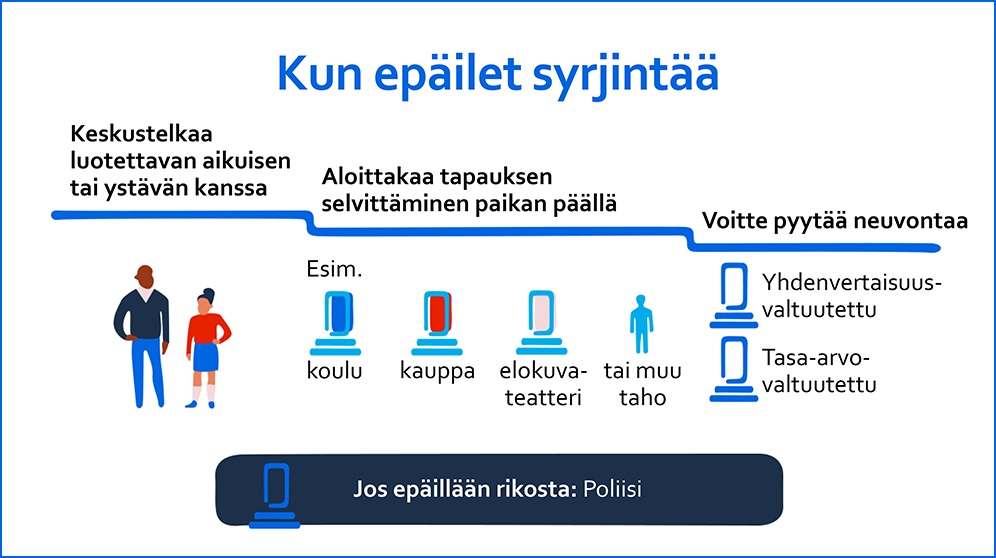
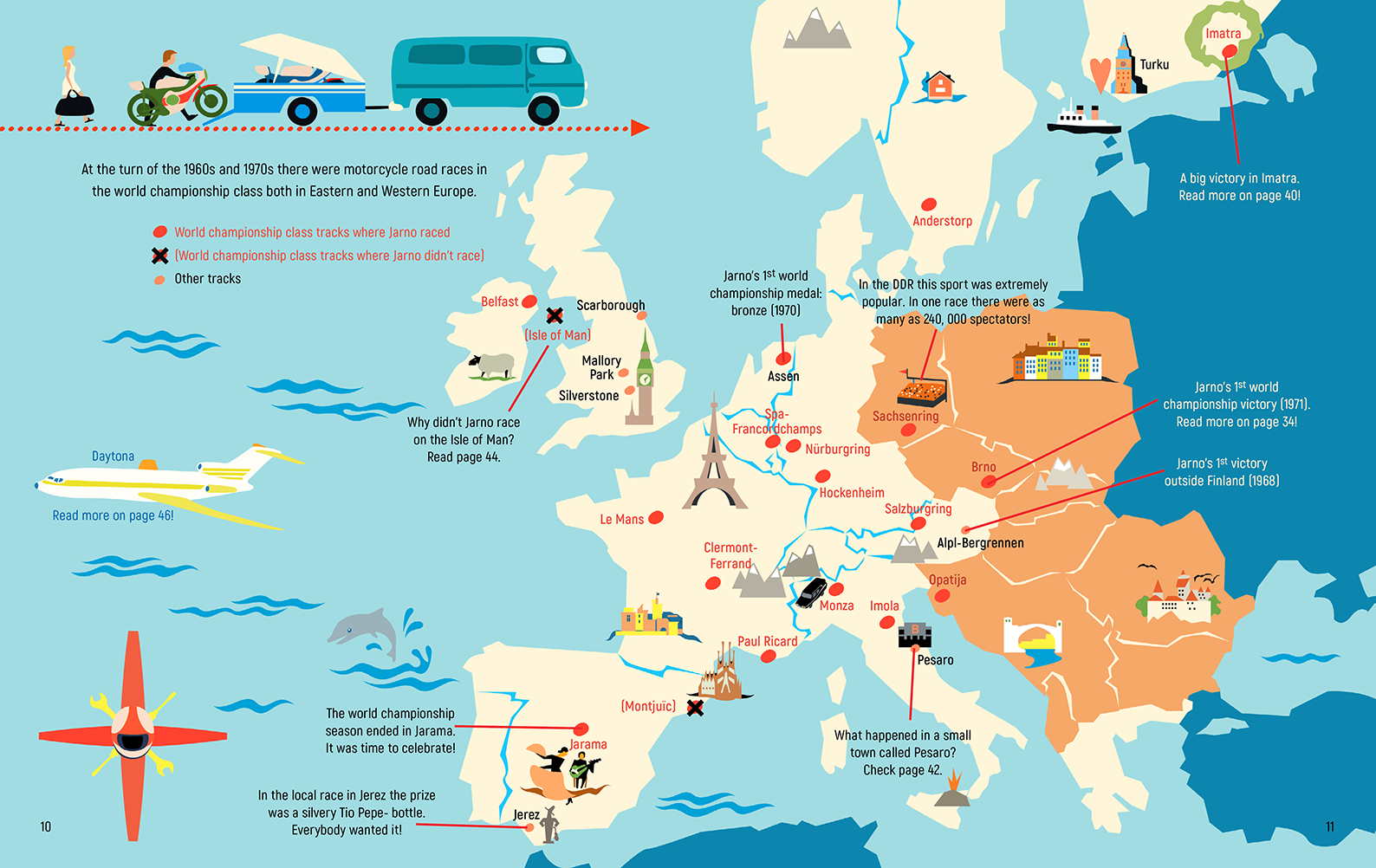
These two pictures above are almost the same shape, but entirely different size. The font size gives it away first. But in a bigger medium you can add more content in general: on the map we see a lot of different things happening on the same spread.
But with a good projector in a good auditorium a presentation easily looks very big. People just don’t come to think of PowerPoint as a small format.
The way I see it, is that the size of one slide is close to sizes on social media: too small for big illustrations or visualizations, but instead you can easily show a series of small ones. There are pros in this, sure. But especially with information and data it’s easy to spot the cons: to begin with, you lose the possibility of showing big picture.
We are living a time with not a lot of big formats, especially in the digital world. But it’s visible in print as well, as newspapers–that only a decade ago were still pretty big–and magazines are transforming into digital versions. We lack the size, but we also lack the time and space to focus on the size that matters.
(Here I’m only talking about the horizontal shapes of our digital world; the ones viewed on laptops and screens. There’s a whole other world happening with the vertical shape, viewed through mobile devices; and when designing for that shape you can easily look at posters for inspiration on composition and catchiness.)
With an infograph, you can summarize and show a lot of information in one single image. Don’t we all know that? But sometimes the hopes for one single infograph can be really high. I’d love to do great infographic summaries and data visualizations for A3 posters or big brochures. It’s just not the reality in most cases.
In many cases, I think people are reaching for formats of the past – and getting unpleasantly surprised by the formats of the present.
Nonfiction picture books can be BIG
Nonfiction picture books, especially the New Nonfiction Picturebooks, the ones that have come out in the last 15 years or so, have certainly tried to do their part in holding the fort for bigger formats. Books such as Maps by Aleksandra and Daniel Mizielińscy (Wydawnictwo Dwie Siostry 2012), Des trucs comme ci des trucs comme ça by Bernadette Gervais (Les Grandes Personnes 2021), One of a Kind by Neal Packer are BIG, to name a few.
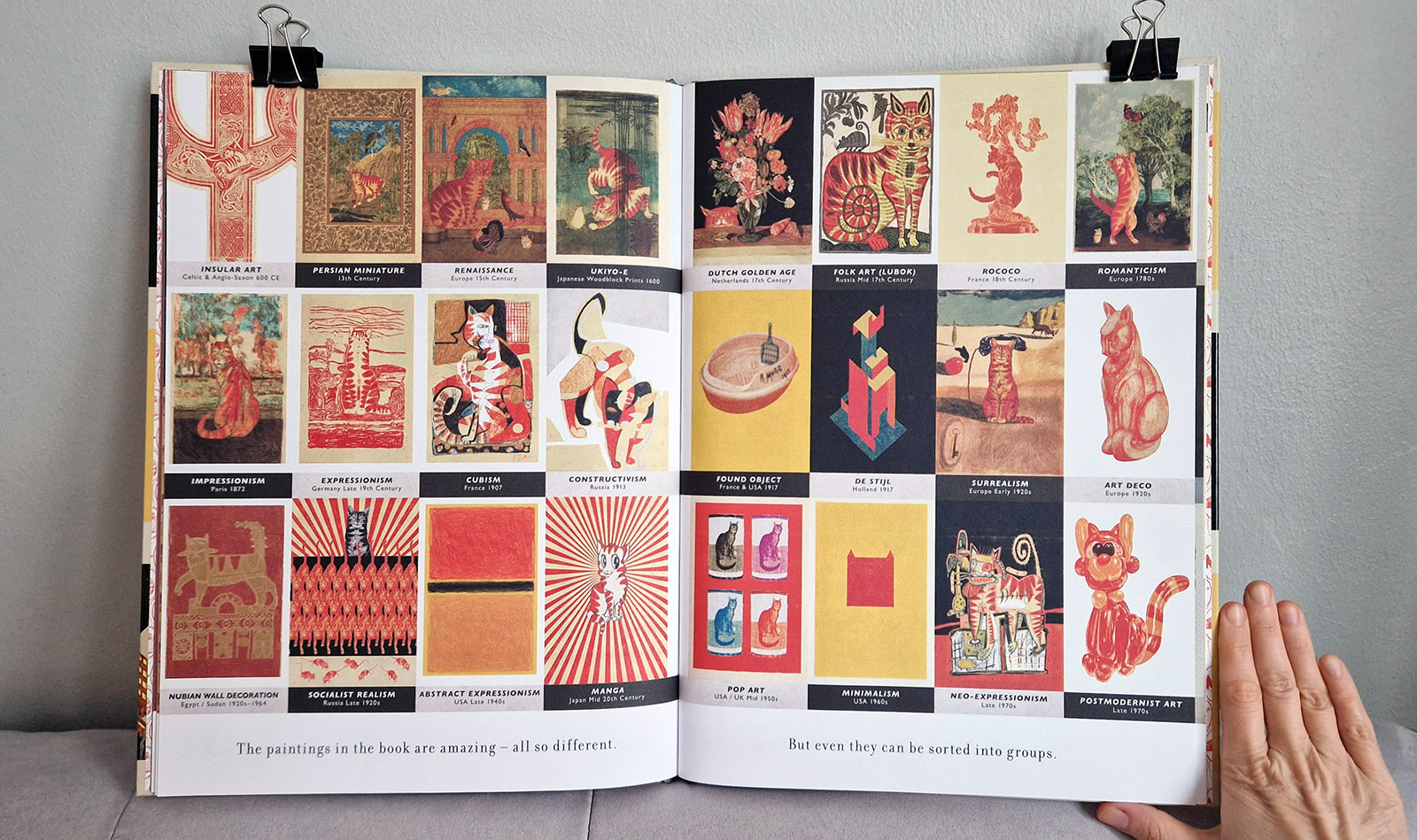
As well as the series of Welcome to the Museum with different authors and illustrators, where all the books come in big size (“oversize” says the publisher).
One of a Kind, in the picture above, is a book that needs to be experienced more so than just read. You never know what the next spread will show, and for the spreads to truly open up to you and reveal their secrets (ie. information and how it is sorted or classified), a little time and focus is needed.
The big picture books are a great antidote for tightly packed, small and fast digital content. I know big books are tricky to shelf in libraries and bookstores. But big formats are just so rare in our lives nowadays, that I’m applauding to them whenever I can.
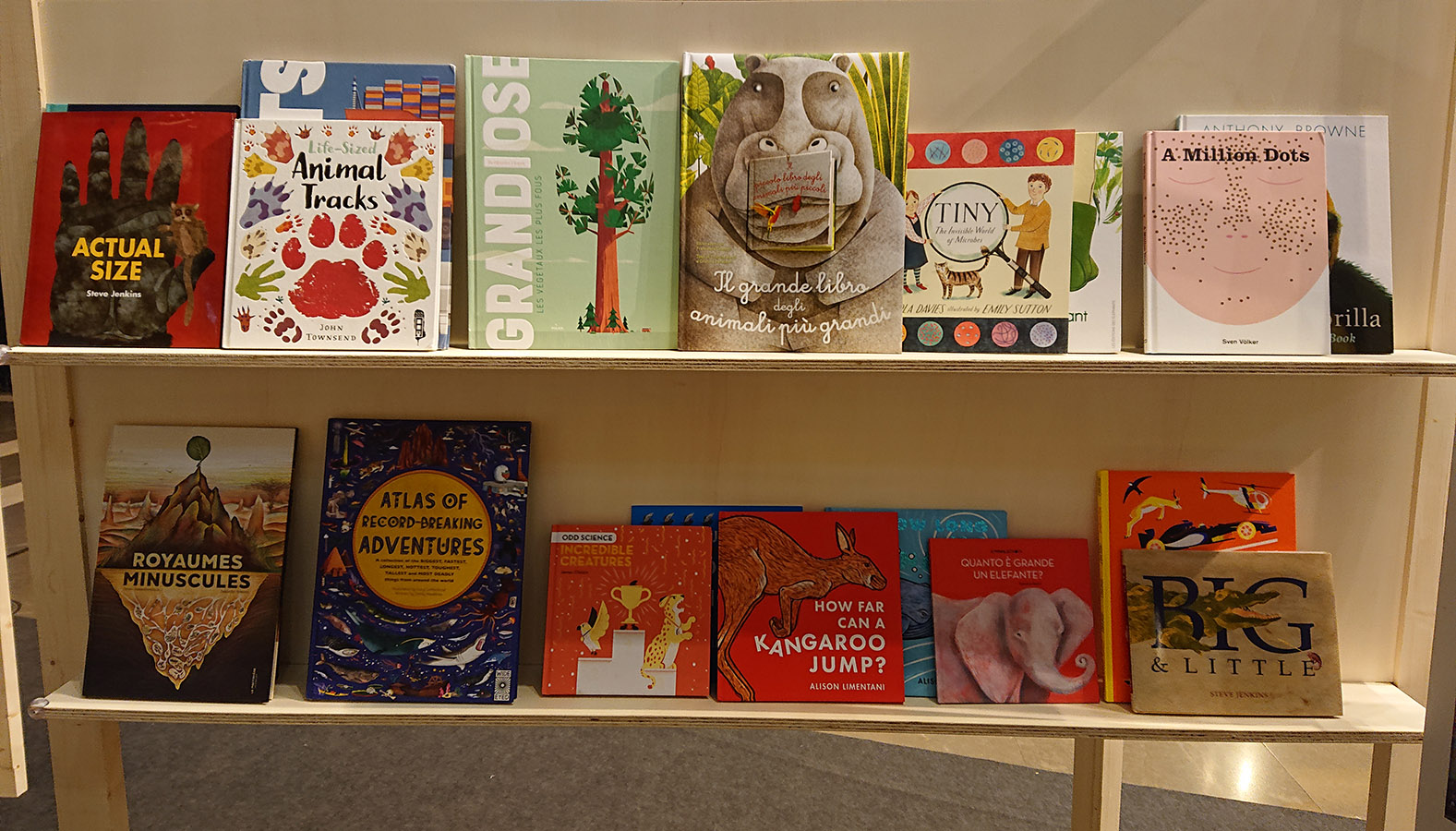
Even though, like shown earlier in the example images, already a lot of normal sized picture books are in fact bigger than most of the sizes we see in our digital life.
Both are created for presenting — mainly
Picture books, like PowerPoints, are created mainly for presenting, together with others, even though they can also be read and beheld on your own. I’d like the drama of picture books to be remembered also with nonfiction: how each spread stands for a new scene with new set of props. This can be true for expository books, sometimes even better than with narrative!
One good example of this is Lifetime: The Amazing Numbers in Animal Lives by Lola M Schaefer & illustrator Christopher Silas Neal, 2013. It depicts the idea of different animal lifetimes through numbers.

You can basically start reading Lifetime anywhere, and each spread definitely has its new set of props as well as actors.
Picture books are great platforms for visualizations. Visualizations can – for example – show size, amounts and quantities or development over time; they can sort and classify; or engage in big picture thinking. These are skills needed in our lives and day-to-day jobs nowadays. The ones we are spending mostly surrounded by social media sized content – and PowerPoint presentations.
 Illustrating Data
Leave a comment